The Limits of AI in Science — Why We Need Self-Driving Labs
Why is AI for materials science harder than AI for biomedicine?
Joseph Krause explains why material performance depends on composition, microstructure, processing, supply chains and manufacturing constraints—and how Radical AI closes the loop between hypotheses, physical experiments and data.
A detailed Latent Space interview with Radical AI CEO Joseph Krause on the distinctive challenges of structural alloys and how self-driving labs could compress the journey from discovery to production.
Understand it in 3 minutesOpen visual and text guide +
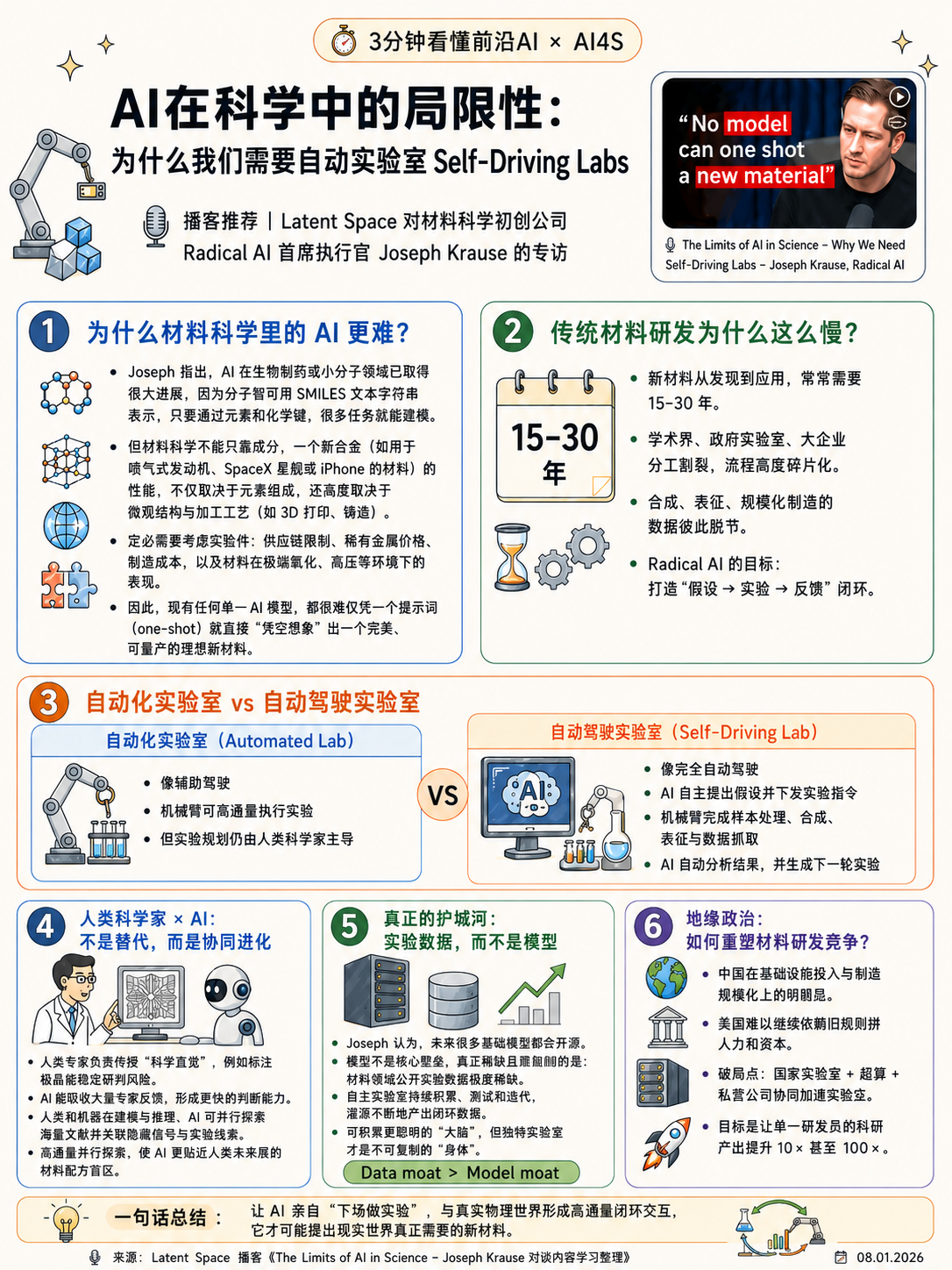
Why is AI for materials science harder?
Unlike small molecules represented with SMILES, a material cannot be understood from composition alone. Microstructure, processing, supply chains, cost and extreme operating conditions all shape performance.
Why does traditional R&D take 15–30 years?
Discovery, validation and scale-up are split across academia, government labs and industry, leaving synthesis, characterization and manufacturing data disconnected.
Automated labs vs self-driving labs
An automated lab executes a human plan at high throughput. A self-driving lab proposes hypotheses, runs experiments, interprets measurements and plans the next round.
How do scientists and AI collaborate?
Experts teach scientific intuition through annotations, while AI connects literature and experimental images at a scale that enables broader exploration of the design space.
The real moat is experimental data
Foundation models may become widely available, but high-quality physical experiment data remains scarce. Infrastructure that continually produces closed-loop data is much harder to copy.
Geopolitics and a new R&D paradigm
Combining national labs, supercomputing and private self-driving-lab technology could multiply individual researcher output and change the basis of materials competition.